

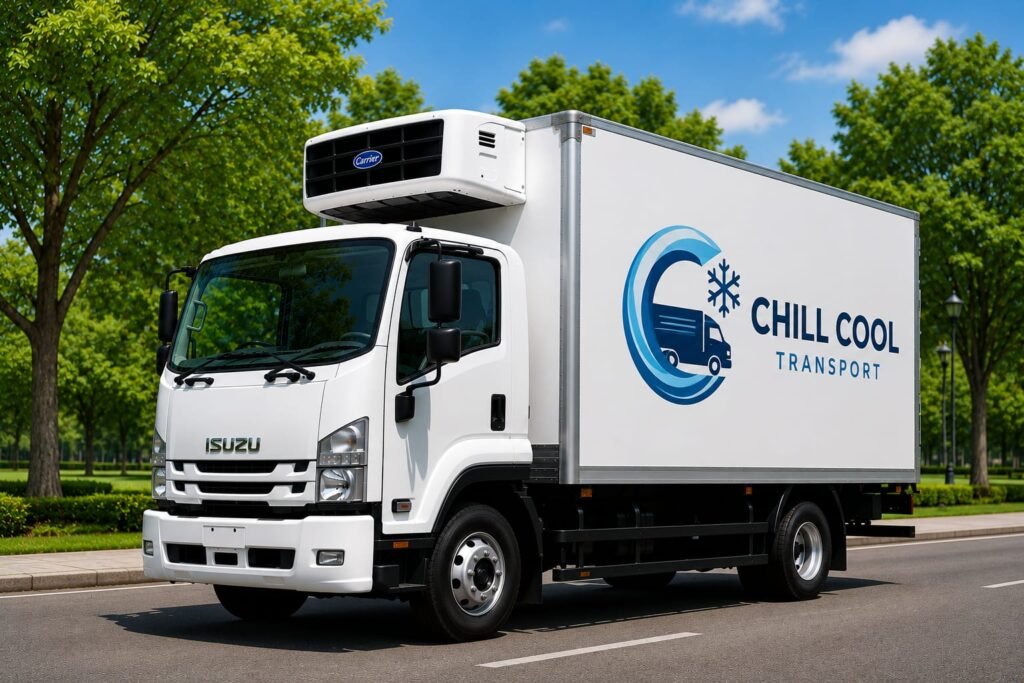
A reefer truck rental service provides a refrigerated truck built around an insulated body and a powered refrigeration unit, rated for pallet-scale freight from roughly 3 to 10 tonnes. The version most professional operators actually need is the multi-temperature reefer — one truck, split by an insulated bulkhead, running a chilled compartment and a frozen compartment on the same trip. Our reefer truck rental in UAE supports chilled and frozen freight on a single journey.
Maintained by the Chill Cool Transports freight desk — the team that scopes reefer truck rental jobs across the UAE daily. Tell us your pallet count, your temperature split and your drop sequence: those three numbers decide the right truck faster than tonnage does.
Half the confusion in this category is vocabulary. Four different things share the word "reefer" — the decision that matters isn't the label, it's how many temperature zones you need and how many pallets you're moving.
| Term | What It Actually Is | When You Need It |
|---|---|---|
| TermReefer van | What It IsLight refrigerated van, under ~1.5T | When You Need ItLast-mile, retail, multi-drop city runs |
| TermReefer truck | What It IsRigid truck, insulated body, 3T–10T, tail-lift | When You Need ItWarehouse-to-store distribution, inter-emirate freight |
| TermReefer trailer | What It IsArticulated semi-trailer, ~20T+ | When You Need ItBulk long-haul, port pulls, GCC cross-border |
| TermReefer container | What It IsShipping container with an integrated cooling unit | When You Need ItSea freight; needs a plug point or a genset once off the ship |
An insulated body is not a refrigerated body. Insulated-only trucks have no active unit — they slow heat gain and nothing more, which is fine for a 20-minute ambient-protected run and useless as a cold chain.
If a quote lands noticeably under the market, confirm three things in writing: the unit is powered and diesel-driven, it is rated for your set point, and it runs while the vehicle is stationary. Those three lines separate cold freight from an insulated box on wheels.
Inside a multi-temperature body, the refrigeration unit feeds more than one evaporator. The main (host) evaporator serves the primary compartment; a second remote evaporator serves the other, each with its own thermostat and set point — divided by a movable insulated bulkhead that slides along rails so compartments can be resized before loading.
A 70/30 chilled-to-frozen truck can’t become 50/50 at your loading bay. Tell the desk the ratio when you book, not when the driver arrives.
The rear of any reefer body is the warm end — every door opening pushes UAE ambient heat straight into whatever sits nearest the doors. Frozen cargo, with the least tolerance for gain, goes furthest from them.
The compartments share an airspace at the seal line. Strongly aromatic cargo — seafood, some cheeses, cut onions — and allergen-sensitive product shouldn’t ride together in the same body regardless of compartment. Tell the desk what’s in both zones and we’ll split the run instead.
If your ratio shifts week to week, say so — standing contracts can carry a variable-bulkhead truck rather than locking you into one configuration.
| Split (Chilled / Frozen) | Typical Use | Watch For |
|---|---|---|
| Split50 / 50 | Typical UseBalanced grocery replenishment, mixed FMCG store drops | Watch ForThe most flexible, rarely the cheapest per pallet |
| Split70 / 30 | Typical UseFresh-led supermarket routes with a small frozen line | Watch ForFrozen zone fills faster than expected — count cases, not pallets |
| Split30 / 70 | Typical UseFrozen distributors carrying a chilled add-on line | Watch ForChilled zone sits at the doors — sequence those drops first |
| Split100/0 or 0/100 | Typical UseSingle-temperature freight | Watch ForBook a straight chiller or freezer truck — it prices lower |
A "heavy van load" is often two or three pallets a 3-tonne reefer truck rental swallows in one trip, tail-lifted in minutes instead of hand-stacked in the sun.
| Size | Pallets (Approx.) | Best For | Tail-Lift | Dual-Zone |
|---|---|---|---|---|
| Size3-Tonne | Pallets3–4 | Best ForStore-level distribution, small mixed loads | Tail-LiftAvailable | Dual-ZoneLimited split |
| Size5–7 Tonne | Pallets6–8 | Best ForMulti-store retail routes, catering supply | Tail-LiftStandard | Dual-ZoneYes |
| Size10-Tonne | Pallets10–12 | Best ForWarehouse-to-warehouse, bulk FMCG | Tail-LiftStandard | Dual-ZoneYes |
| SizeReefer Trailer | Pallets20+ | Best ForPort pulls, GCC long haul | Tail-LiftDock-level | Dual-ZoneYes |
Refrigeration units can run continuously or cycle on and off with demand. It's a live cost-versus-stability trade-off, and almost nobody discusses it with customers.
Holds the tightest temperature band and keeps airflow constant. The right setting for frozen, for pharma, and for any multi-drop route in a UAE summer. It burns more fuel.
Saves fuel and is acceptable for robust chilled cargo on short, low door-count runs. On a hot day with frequent stops, it lets the band widen between cycles — exactly when a customer photographs a thermometer reading and disputes the delivery.
We default to continuous for frozen and mixed loads. If a quote you’re comparing is unusually low for frozen freight, running mode is one of the places that saving is coming from.
A reefer truck rental unit doesn't cool cargo — it moves air. If the air can't complete a circuit around the load and return to the evaporator, the display will read perfectly while the pallets at the tail drift out of range.
01
Every reefer truck rental body carries a marked load line below the ceiling. Stacking through it blocks the discharge air stream at its source.
02
03
04
The one line to take from this section: freight has to arrive at temperature. A reefer truck rental unit is sized to remove heat leakage and the heat you load in — not to pull a warm pallet down in transit. Cargo loaded at +10°C is cargo delivered at roughly +10°C, with a flawless log proving the truck did exactly what it was asked to. Pull-down belongs in the cold store.
A reefer truck rental display can show you several numbers, and people argue over the wrong one.
This is where a professional buyer decides, and where most rental pages say nothing beyond "HACCP certified."
Reefer trucks in the UAE spend a large share of their life around the ports and free zones, and that work has its own failure points.
A reefer container is fine while it’s on a terminal plug point. The clock starts when it’s unplugged, and unless a genset is fitted, cooling stops. Clearance delays are the standard reason a load arrives out of range.
Perishables moving to or from DXB cargo village and Al Maktoum (DWC) are scoped against a flight reference, not a time of day. Send the AWB and the cut-off when you book an airside leg.
Chill Cool Transports reefer truck rental starts from AED 500 per day for a 3-tonne truck, with weekly rates from AED 3,000 and monthly rates from AED 8,800. Larger 5-7 tonne and 10-tonne trucks are priced by size and term. Dual-zone loads are quoted once we know your split ratio, pallet count and route. Rates as of October 2026.
Daily, weekly and monthly rates by truck size. Standing contracts priced lower.
From AED 500 / Day| Truck Size | Pallets | Per Day | Per Week | Per Month |
|---|---|---|---|---|
| 3 ton Reefer | 3-4 | AED 500 | AED 3,000 | AED 8,800 |
| 5 ton to 7 Ton ReeferDual-Zone | 6-8 | AED 650 | AED 3,900 | AED 11,000 |
| 10 ton ReeferDual-Zone | 10-12 | AED 800 | AED 4,800 | AED 13,000 |
| Factor | Effect |
|---|---|
| FactorZones | EffectDual-zone costs more than single-zone; two set points, more unit runtime |
| FactorTruck size | EffectPriced by pallet capacity, not kilometres alone |
| FactorRoute | EffectIntra-city below inter-emirate; GCC quoted separately |
| FactorTerm | EffectStanding contracts price well below repeated one-off hires |
| FactorSchedule | EffectPlanned daytime below overnight, same-day and emergency dispatch |
| FactorWaiting / detention | EffectThe line most quotes hide — ask what's included before you compare two rates |
Backhaul: if your truck returns empty, tell us the return leg and timing pairing a return load against another client’s route is the most reliable discount in cold freight, and it only works if you mention it.
Almost every competitor page quotes one commercial model. Freight buyers work in three, and picking the wrong one is where cold-transport budgets leak.
01
02
03
Rent versus own, in one line: owning makes sense when a truck is loaded most working days of the year; chartering makes sense when demand is seasonal, contract-linked, or growing faster than you want to buy assets. Most UAE distributors we work with run a small owned core and charter the peaks.
A PTI (pre-trip inspection) is the record that the unit can hold what it promises. Before a reefer truck leaves our yard:
The unit is run up at your assigned set point, not simply switched on and reported as working.
Door seals, hinge alignment, bulkhead seal and the rear curtain are checked.
Ask any operator you’re comparing whether they run a PTI and whether the record is available to you. The answer sorts the UAE market faster than any rate comparison.
01
02
03
04
05
06
07
08
One freight desk providing reefer truck rental in UAE, covering Dubai, Abu Dhabi, Sharjah, Ajman, Ras Al Khaimah, Fujairah and Umm Al Quwain, with GCC routes quoted on request.
We size your reefer truck rental, set the bulkhead ratio and price it — usually within the hour.
01
02
03
04
The one line to take from this section: freight has to arrive at temperature. A reefer unit is sized to remove heat leakage and the heat you load in — not to pull a warm pallet down in transit. Cargo loaded at +10°C is cargo delivered at roughly +10°C, with a flawless log proving the truck did exactly what it was asked to. Pull-down belongs in the cold store.
Roughly 3–4 in a 3-tonne, 6–8 in a 5–7 tonne, and 10–12 in a 10-tonne. Reefer trucks trailers carry 20 or more. Pallet count sizes the job faster than tonnage.
Copyright © Chillcooltransports | All rights reserved. Design and Ranked by MindGigs